
I came across this piece the other day and still felt it was relevant. At this point, Thomas Was Alone is available on pretty much everything (even your iPad). Give the game a chance if you haven’t happened to play. Never know what life lessons you can learn from colorful shapes. – Bryan

We are not meant to go at this life alone.
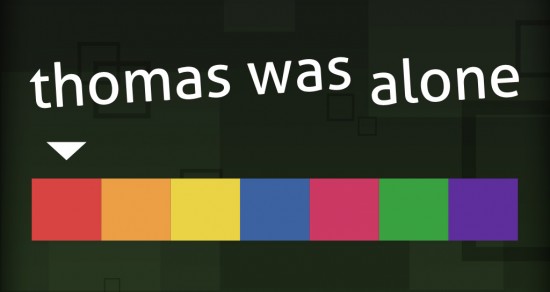 Thomas Was Alone drives home the point that we are meant to live in community with others. As the levels in Thomas progress, the game reinforces that red rectangle Thomas needs others to move from one point to another. Thomas cannot move through the game world alone.
My son graduated from kindergarten today (5/29/2015). I’m not sure how I feel about that. Sitting there in the auditorium, I was reminded of what big personals events were like growing up. I remember having the biggest cheering section out of anyone. My parents, siblings, grandparents, aunts, uncles, and cousins were always there to cheer me on. I wasn’t alone.
 Thomas Was Alone combines minimalist design and expert narration to introduce characters one cares for. Take Claire for instance. Claire is a large blue square. Even though she cannot jump high, Claire dreams of becoming a superhero. Thomas and his friends need Claire. She is the only one that can float across the toxic waters that would kill anyone else in an instant.
The Bible talks about the human body having many parts, each with it’s own task, function, and purpose. The Bible likens the human body to the body of Christ. In that we are meant to live in community.
I teach a group of men on Wednesday nights. We’ve been going through some difficult material. Peeling back masks and becoming real with one another, I have learned that we all have a need for friendship. Most of us feel as if we do not have anyone to walk in life with. We feel alone. Sometimes lost. Isolated within our families, running the race of life. The guys and I discussed how we can move beyond our personal islands:
- Reaching out, in person, on the phone, even a simple text
- Having a bigger focus than just ourselves
- Being legacy minded
God lives in community with the Holy Spirit and Christ. If He is our example. . . it may be time to pick up a phone, knock on a door, and connect.


 JohnnyBGamer