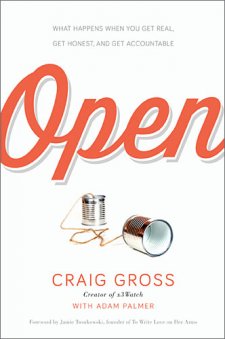
Book Review: Open by Craig Gross

The first time I heard the word accountability was shortly after high school. A good friend of mine asked me if I wanted to be accountability partners with him. This meant that we would talk about the deeper things that boil beneath the surface; things that most hold tightly to themselves. I am not sure if I was scared or what, but I quickly declined his invitation. I did not want anyone getting closer. I was an island.

No man is an island,
Entire of itself,
Every man is a piece of the continent…

– No Man Is An Island, John Donne

Open, by Craig Gross, is a book that encourages living a life in accountability to another. The book is divided into three parts:

  1. Part 1: Why accountability is…(Good, Safety, Deep, Necessary)
  2. Part 2: What you need…(Honesty, Courage, Help)
  3. Part 3: How – Get…(Involved, Intimate, Effective)

Open by Craig Gross

The Good:

Starting in Chapter 8, I love how Craig breaks down exactly how to establish an accountability relationship and exactly what that looks like. He talks about the small things such as:

  • Picking someone of the same gender.
  • Finding someone you are compatible with (preferably someone who knows you).
  • Having an accountability partner whose views are slightly different than your own (this way you avoid someone who is simply going to be a yes-man and will instead challenge you).
  • Choosing someone who you can trust. I have found point to be especially true. If you don’t trust your accountability partner you will never go below the surface conversations that you have with everyone else.
  • Taking into consideration whether you want someone in the same stage of life (income, age, marital status, kids, etc.) as yourself.

Though Craig’s background is primarily in dealing with pornography through XXXChurch, in Chapter 9 he goes beyond porn in asking, “What are you seeking accountability for?” (p146). This is a fantastic question because accountability can be for almost anything from exercise to the spiritual discipline of reading the Bible. I know that when I hear the word accountability I automatically think of someone needing to overcome some sort of terrible sin.

Finally, in Chapter 10, Craig discusses scheduling, deciding on a meeting place, and what the format for an accountability meeting looks like.

“Honesty can be spontaneous, but spontaneity often arises from planning.” (p171)

He suggests:

  • Five minutes of small talk
  • An opening prayer
  • A series of staple questions you ask each other each week (“How was your week? Were you honest and truthful in all you did? State one lie you have told someone in this past week or a secret you are keeping from someone else or the group.” (p173))
  • Asking specific questions that apply directly to you (Did you steal from the cookie jar?)
  • Closing prayer
  • Further discussion/ small talk
  • Close

The Bad:

I dislike the tone that Craig writes with at the beginning of Open. The first few chapters paint a picture of a man who is all about self promotion/himself. This turned me off to the book and caused me to skim until I found material that was actually helpful and worth reading (the back half/practical end of the book). This is a shame as I can see this as a turn off to other readers.

In Closing:
Despite a poor beginning, Open features useful discussion on the why’s, how’s, and what’s of going beyond the personal island and seeking out others to walk through life with.

I was given a copy of this book by BookSneeze. All opinions are my own. I was not required to write a positive review.

Healthy Christian Criticism

darksiderswar

Have you ever wondered what healthy Christian criticism looks like in regards to video games? I know that often I have been guilty of intentionally writing a negative review from the outset. I am guilty of making blanket statements just because I have been offended by a gameplay mechanic or content found in a game. Just because I am/was offended, I have illogically reasoned, all Christians must flock to my side and be offended as well. As I have grown and matured in my walk with Christ, I have found that criticism is a much more nuanced creature.

Of Games & God

Kevin Schut, in his Of Games & God: A Christian Exploration of Video Games, talks about what healthy Christian criticism looks like:

To start with, good criticism is not automatically positive or negative. If we want to judge something fairly, we can’t prejudge it (although it’s impossible to completely avoid this). We also can’t judge something without examining it. p.175

Schut continues by saying that context is the key in:

…understanding where a game fits in gaming culture, in the gaming industry, and in relation to other games. p.175

Just as when we study the Bible, we must also examine the cultural and historical context of what we are reading. Asking questions such as:

  1. What is the developer/author/writer trying to communicate?
  2. What does this mean in light of the overall video game industry and it’s history?

7674.Pong

The book continues:

…good criticism draws on or at least considers as many different critical perspectives as possible, even if we ultimately reject some of those ideologies.

Carefully considering non-Christian perspectives is, in my opinion, a healthy thing to do. Healthy Christian criticism is not defensive or prickly. p.175

In dealing with non-Christians online, I often find myself getting defensive (even with fellow Christians). This is not how Jesus would have responded. I have found that when I start growling that this is a signal to take a breather and step away from the situation. We don’t always have to have the answer or the last word, right? Right?

Fourth, my faith, the teachings of Christian tradition, and the words of Scripture are by far the greatest motivator in my criticism.

My worldview is based on my belief in Jesus… p.176

And finally:

…good criticism leaves the door open to the possibility of a change in perspective. p.176

Again, how often do we come to the virtual table with prejudged notions. I have noticed a disturbing trend in some online Christian communities where anyone that thinks differently than the group norm is quickly shutout and shutdown. Open communication and a lack of fear of where a conversation might head are needed with good criticism, period.

Healthy Christian criticism comes from a non-reactionary place filled with grace. In light of Scripture, we are able to take that which we consume and weigh it accordingly.

Hope

Many years ago, I had the privilege of reading Cormac McCarthy’s The Road. The story is about a father and son making their way south after their world has been torn asunder. As the world grows grey and bleak, cannibals scour the roads and food becomes a memory of the past. Dread, fear, and hopelessness saturate the book just as summer thunderstorms do in Texas. I found The Road to be haunting and an absolutely memorable page turner.

The Road

In 2009, director John Hillcoat brought “The Road” into the darkness of movie theaters. The movie did not look like a joy-filled affair, faithful to the book, so I passed on it. Recently, I discovered that Netflix had added “The Road” to their vast library. So last night I sat down and watched as much as I could stomach. The sense of hopelessness and dread eventually did me in as the two main protagonists entered a house/mansion. Memory recalls that houses, in the book, were places that either served to replenish dwindling supplies or as examples of how far the human soul can fall. The foreboding feeling I felt told me that this particular house held untold horrors. Simply and quietly, I turned the movie off.

As the screen faded back to the familiar Netflix menu, I knew my night needed a palette cleanser. Kevin Costner’s “Dances with Wolves” provided just that.

Dances with Wolves

With the inspiring beauty of the American frontier, “Dances with Wolves” offers hope in solitude. Grand vistas of the rolling prairie soaked in sunlight stood in absolute contrast to the devastating world of “The Road”. Though not intentional, I ended up watching two movies that highlight being alone, cut off from a civilized world. While “The Road” wallows as the world begins to literally dim, “Dances with Wolves” embraces that which has made America an exceptional nation, hope.

Design a site like this with WordPress.com
Get started